I ran marketing in-house for a foundation repair company in Dallas-Fort Worth for over a decade. Not as a consultant. Not as an outside agency. I sat in that building every day, and when the phones didn't ring, it was my problem.
Over those 10 years I managed 8 Google Business Profiles, built out hundreds of service and location pages, and helped generate 200+ leads per month. Those GBP profiles alone drove roughly $3 million a year in revenue. Local SEO wasn't one channel among many. It was the engine.
This is the playbook. Everything I learned about local SEO for contractors, stripped down to what actually moves the needle.
What local SEO actually means for a contractor
Local SEO is the process of getting your business to show up when someone in your area searches for a service you offer. If you want the full picture of how it fits into a bigger digital marketing strategy, I wrote a complete guide on that too. "Roofer near me." "Foundation repair Dallas." "HVAC contractor Fort Worth." Those searches have buying intent. The person isn't browsing. They need someone now.
There are really two battlefields. The map pack (those top 3 Google Maps results with the map) and the organic results below it. Winning both is the goal. But if I had to pick one, the map pack generates more phone calls for local service businesses than anything else.
The best part? Once you rank, the leads don't stop when the budget runs out. Paid ads turn off the second you stop paying. SEO compounds. Every month you invest builds on the last.
Why local SEO beats paid ads long-term
I'm not against ads. I run them for clients. But I've watched too many contractors dump $2,000 a month into Google Ads with no SEO foundation and wonder why they're not growing.
Ads are a faucet. Turn them on, leads flow. Turn them off, they stop. Local SEO is more like a well. It takes time to dig, but once it's producing, the water keeps coming.
One of my clients, a brand new land clearing company with zero online presence, went from $0 to $30K+ a month inside his first two months. All organic. Zero ad spend. He was ranking #1 in the local map pack within weeks.
September 2026 update: That company, EarthWorx Land Management, reached $100,000 in monthly revenue and six machines in eight months. This is Brandloc's latest client update, following the original month-two milestone above. See the full EarthWorx case study.
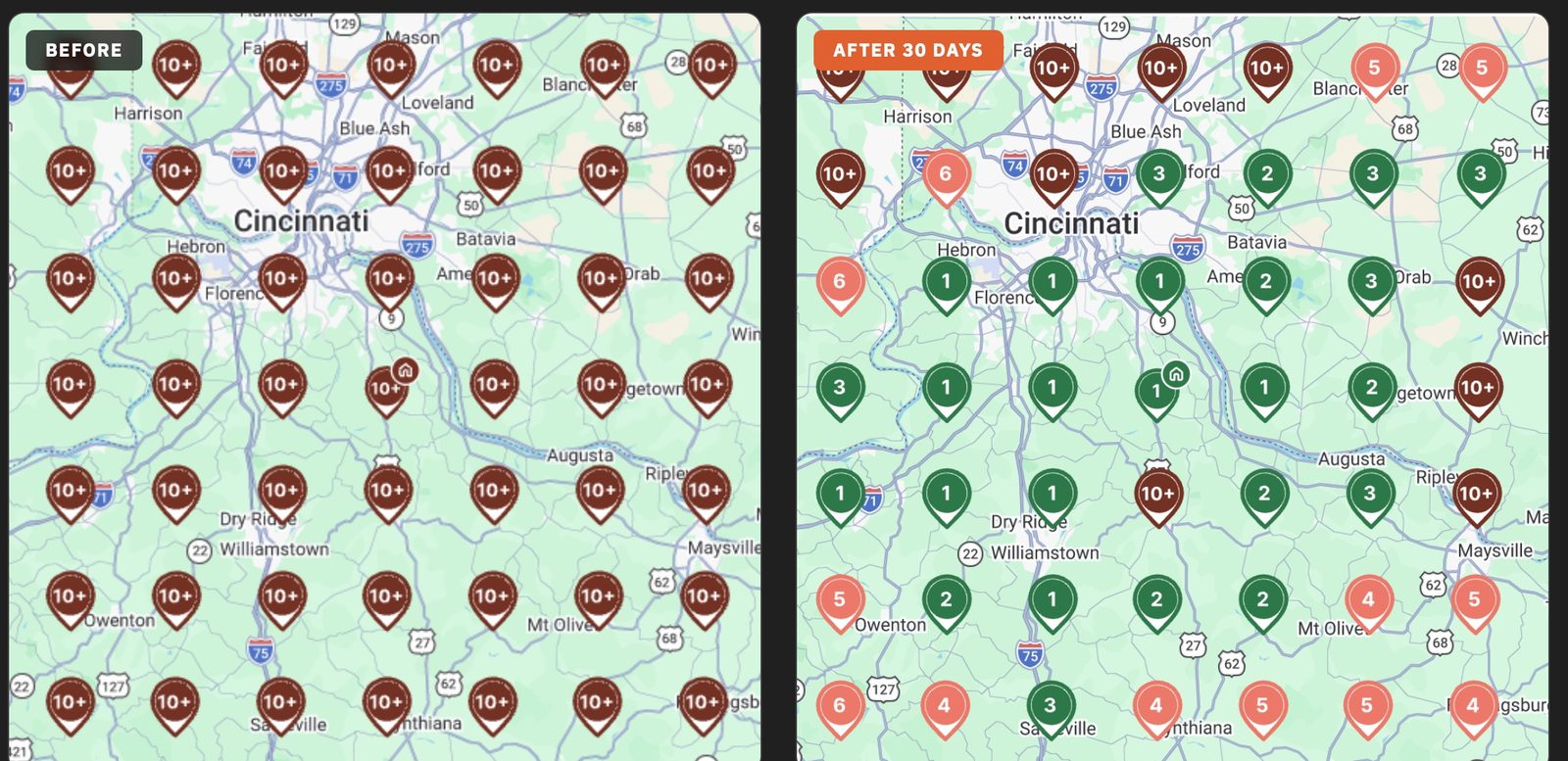
The contractors who invest in local SEO now are the ones who'll still be getting calls five years from now. The ones chasing cheap leads from ads without building anything underneath will always be on the treadmill.
Your Google Business Profile is the starting line
Your Google Business Profile is the single most important asset for local SEO. Full stop. If your GBP isn't optimized, you're not showing up in the map pack, and you're losing calls to competitors who are.
The things that actually matter: your primary category is the biggest ranking factor, and "Plumber" vs "Plumbing Service" will give you completely different results. Fill out every single field. Services, business description, service areas, hours, attributes. Upload real photos of your work, your crew, your trucks. Post weekly. Most contractors never post on their GBP, so doing it consistently already puts you ahead.
Reviews are a ranking factor too, and I'll get into that more below. But the short version is that a GBP with 150 reviews will outrank one with 12 every time, all else being equal.
Your GBP and your website aren't separate strategies. They feed each other. The stronger your website's SEO, the better your GBP ranks in the map pack. Treat them as one system.
On-page SEO: the basics that most contractors skip
Every page on your website needs to target a specific keyword. Not three keywords. Not a vague topic. One clear keyword per page.
That means a unique title tag, a unique meta description, and content that genuinely helps someone searching for that term. Your homepage should target your primary service plus your main city. "Foundation Repair in Dallas, TX" not "Welcome to ABC Foundation."
Use your keyword naturally in the H1 heading, in the first 100 words, and in a few subheadings. Don't stuff it. Google is smarter than that now. Write for the person reading the page first, then make sure the technical boxes are checked.
Page speed matters too. Over 60% of your traffic is coming from a phone. If your site takes more than 3 seconds to load on mobile, people bounce before they ever see your phone number.
Service area pages are where the real wins hide
If you serve 15 cities, you need 15 location pages. "Foundation repair McKinney TX" and "foundation repair Plano TX" are different searches with different competition. A single "Service Areas" page with a list of city names does almost nothing.
Each page should have unique content about that specific area. Mention the city name naturally, reference local landmarks or neighborhoods, include testimonials from customers in that area if you have them, and make sure the page has a clear call to action with your phone number and a form.
This is one of the fastest ways to expand your organic footprint. I've seen contractors go from ranking in one city to ranking in eight just by building out proper location pages with real content on each one.
The same logic applies to services. If you offer five different services, you need five dedicated service pages. A single "Our Services" page with bullet points won't rank for anything specific.
Citations: boring but necessary
A citation is any mention of your business name, address, and phone number on another website. Yelp, BBB, Angi, Thumbtack, your local chamber of commerce, industry-specific directories. Google uses these to verify that your business is real and that your information is consistent.
The key word is consistent. If your GBP says "123 Main St" but Yelp says "123 Main Street" and the BBB has an old phone number, that inconsistency hurts your rankings. Audit your citations. Make sure your NAP (name, address, phone) is identical everywhere.
You don't need 500 citations. You need 30 to 50 high-quality, accurate ones. Get listed on the major platforms, the top industry directories, and any local business directories in your market. Then move on to things that matter more.
Schema markup: speak Google's language
Schema markup is structured data you add to your website's code that tells Google exactly what your business does, where you're located, what services you offer, and what your customers say about you.
Most contractor websites don't have it. Which means if you add LocalBusiness schema, Service schema, and FAQ schema to your pages, you're immediately giving Google more information about your business than your competitors are giving about theirs.
This isn't something you'll see on the page. It's invisible to visitors. But Google reads it, and it can help you show up in rich results, knowledge panels, and AI-generated answers. It's one of those things that takes an hour to implement and pays dividends for years.
Reviews are a ranking factor, not just social proof
Google has confirmed that review quantity, velocity, and diversity are ranking factors for the map pack. More reviews, more recent reviews, and reviews that mention specific services and locations all help.
But you can't just ask once and hope for the best. You need a system. An automated review request that goes out after every completed job. A follow-up if they don't respond. A process for responding to every review, positive or negative, because Google tracks that too.
"John did an amazing job on our foundation repair in McKinney" is worth ten times more than "Great work." Keywords in reviews matter. You can't tell customers what to write, but you can ask specific questions that lead to detailed responses: "Would you mind mentioning the service we did and your city?"
Blog content: capture the questions your customers are asking
Blogging isn't about publishing for the sake of it. It's about capturing informational searches that your service pages can't target. "How much does foundation repair cost?" "Signs your foundation is settling." "Do I need a permit for a new roof in Dallas?"
These are searches from people who aren't ready to buy yet but will be soon. When they eventually need the service, they'll remember you because you were the one who answered their question.
One blog post a month is enough if it's targeting a real keyword with real search volume. Quality over quantity. I'd rather have 12 well-researched posts that each rank on page one than 50 thin posts that rank for nothing.
Link your blog posts to your service pages and vice versa. Internal linking helps Google understand your site structure and passes authority between pages.
AI search is already changing the game
Google AI Overviews and ChatGPT are pulling information from websites and presenting it directly in search results. This isn't a future trend. It's happening now.
My clients are showing up in Google AI Overviews and ChatGPT within days of launching their sites. Days, not months. The contractors who have well-structured, authoritative content with proper schema markup are the ones getting featured.
If your website is thin, outdated, or missing structured data, AI-powered search engines have no reason to reference you. The same SEO fundamentals that help you rank in traditional search are what get you cited in AI-generated answers. This is only going to become more important.
The prioritized action list
If you're starting from scratch or your current SEO isn't working, do it in this order:
- Claim and fully optimize your Google Business Profile. Correct category, complete info, real photos, weekly posts. This is the fastest win.
- Fix your website fundamentals. Unique title tags and meta descriptions on every page, phone number and form above the fold, mobile-friendly, fast load times.
- Build dedicated pages for every service you offer and every city you serve. One keyword per page. Real content, not filler.
- Add schema markup. LocalBusiness, Service, FAQ, and Review schema at minimum.
- Build 30 to 50 accurate citations on major directories. Make your NAP consistent everywhere.
- Start collecting reviews systematically. Automate the ask after every job.
- Publish one blog post per month targeting a real keyword your customers are searching.
- Monitor your rankings, your traffic, and most importantly your leads. SEO that doesn't generate phone calls isn't working.
You don't need to do all of this in a week. But the contractors who work through this list consistently, month after month, are the ones who end up dominating their local market.
Stop leaving leads on Google
I've watched contractors go from invisible to #1 in the map pack. I've seen a brand new company with zero online presence go from $0 to $30K+ a month in organic revenue. None of it was magic. It was this playbook, executed consistently.
If you'd rather not run this playbook yourself, this is the work a marketing agency for contractors should be doing for you - and in some trades it pays to hire a specialist, like land clearing. If you want to know where your local SEO stands right now and what's costing you leads, grab a free audit. I'll show you exactly what's working, what's broken, and what to fix first.